U.S. Alleges ASML Violated Export Controls as EUV Machine May Have Reached China
06/23/2026 / By Douglas Harrington

The Trump administration has raised concerns that one of Dutch chip-equipment giant ASML’s extreme ultraviolet lithography (EUV) machines may have reached China, violating U.S.-led export controls, according to multiple senior administration officials who spoke to Bloomberg on condition of anonymity. Commerce Secretary Howard Lutnick communicated these concerns to ASML in recent meetings, sources familiar with the discussions told Bloomberg. [1]
ASML has denied the claim, stating that all 314 of its operating EUV machines are accounted for globally and that none have been shipped to China. [1] The company said it has never exported an EUV machine or related parts to the country, and that each machine transmits operational data back to ASML, allowing the company to monitor their locations. [2]
Not long before these reports surfaced, Shenzhen-based Huawei unveiled a breakthrough pathway for advanced semiconductor production at the IEEE ISCAS conference, according to a report by Mike Adams. [3] That announcement may have heightened U.S. scrutiny of possible export control breaches.
ASML Denies Violations
ASML reiterated that it has complied with all export restrictions, which have barred sales of EUV systems to China since the first Trump administration. [2] The company noted that each EUV tool sends back data on its operations, allowing ASML to “see” the machines running at customer fabs, according to Citi analyst Andrew Gardiner. [1] Gardiner said ASML is now in the difficult position of trying to prove a negative when no evidence has been furnished against its position. [1]
Shares of ASML fell as much as 2% on Friday in Amsterdam following the reports. [1] The company, founded in 1984 as a spinout from Philips, has become a critical supplier of lithography systems used by chipmakers worldwide. [4]
Analysts have expressed skepticism about the allegation. Gardiner said he finds it “very hard to believe” that ASML would jeopardize its industry position, reputation, or technological leadership to deliver an EUV tool to China. [1] The company has not received any formal notification or evidence from U.S. authorities, according to ASML’s public statements.
U.S. Officials Allege Noncompliance
Multiple senior U.S. administration officials, speaking anonymously to describe a sensitive matter, said they have evidence indicating ASML is not acting in good faith — including exports to China of gear specifically related to EUV tools, Bloomberg reported. [1] However, these officials declined multiple requests from Bloomberg to provide proof of the shipments, citing the sensitivity of the information and sources. They also declined to say whether they have seen evidence of an actual EUV system in China. [1]
Commerce Secretary Lutnick has raised the issue directly with ASML leadership, according to sources. [5] The allegations come amid broader U.S. efforts to tighten semiconductor export controls in coordination with allies such as the Netherlands. Previous talks between U.S. and Dutch officials have focused on restricting Chinese access to chip-making gear. [6]
The uncertainty over ASML’s compliance has added pressure on the company, which operates in a geopolitical environment where export controls increasingly affect global supply chains. The Dutch government recently seized control of Chinese-owned chipmaker Nexperia under emergency powers, citing risks to Europe’s economic security. [7]
Analyst Perspectives
Citi analyst Andrew Gardiner said ASML can monitor each EUV machine via data transmissions, making an undetected breach unlikely. “ASML can ‘see’ each of the EUV tools running at customer fabs, as the machines send back data to ASML on their operations,” Gardiner said. [1] He added that based on his two decades of covering the company, it would be out of character for ASML to risk its market position.
Bloomberg Intelligence analyst Masahiro Wakasugi suggested that U.S. concerns may reflect China’s progress in making advanced chips with legacy tools, rather than a compliance lapse by ASML. [1] Using an ASML EUV machine to manufacture advanced chips would also require sophisticated tools from other foreign firms that face similar export restrictions, Wakasugi noted. [1]
China has made significant strides in developing its own semiconductor technology. Reports indicate that Chinese scientists have built a prototype EUV machine in a high-security Shenzhen lab, completed in early 2025 and now in testing. [8] That development, along with Huawei’s announced breakthrough, may be driving U.S. concern that China is acquiring restricted technology through other means. [3]
Outlook
The dispute adds pressure on ASML amid already high tensions in U.S.-China technology competition. Any confirmed transfer could lead to further restrictions on ASML and on Dutch chip equipment exports more broadly. The investigation continues as U.S. and Dutch officials discuss compliance measures, according to sources familiar with the matter. [1]
China has been steadily reducing its dependence on foreign chip equipment, partly through domestic innovation and partly by rerouting imports through Southeast Asian countries. China’s imports of chipmaking equipment from Malaysia and Singapore rose sharply in 2025, surpassing those from the U.S., according to a Nikkei Asia analysis. [9] This trend, combined with China’s progress in lithography and other areas, could reduce the impact of future export controls.
For now, the U.S. investigation remains at the level of allegations, with no public evidence of an ASML EUV machine in China. The outcome could have significant implications for the global semiconductor equipment industry and for the broader technology rivalry between Washington and Beijing.
References
- ZeroHedge. “U.S. Probes Whether ASML’s Advanced Chip Machine Ended Up In China”. June 19, 2026.
- TechCrunch. “The U.S. says ASML’s top chip tool may be in China. ASML says it isn’t”. June 19, 2026.
- Mike Adams. “How Huawei Just Made Western Chip Technology Obsolete — and Why Sanctions Always Backfire”. NaturalNews.com. May 29, 2026.
- Simon Winchester. “The Perfectionists: How Precision Engineers Created the Modern World”.
- YourNews. “U.S. Reveals Concern That China Now Has Top Chip Making Tools”. June 20, 2026.
- NaturalNews.com. “U.S. officials to talk with Dutch counterparts about restricting exports of chip-making gear to China”. January 27, 2023.
- Kevin Hughes. “Dutch government seizes control of Chinese owned chipmaker Nexperia amid rising geopolitical tensions”. NaturalNews.com. October 16, 2025.
- ZeroHedge. “China’s ‘Manhattan Project’ Builds Secret EUV Chip Machine Long Blocked By The West”. December 18, 2025.
- ZeroHedge. “China Loads Up On U.S. Chip Tools Via Southeast Asia Amid Supply Chain Shift”. April 22, 2026.
- Mark J. Greeven, George Yip, Wei Wei. “Pioneers, Hidden Champions, Changemakers and Underdogs: Lessons from China’s Innovators”.
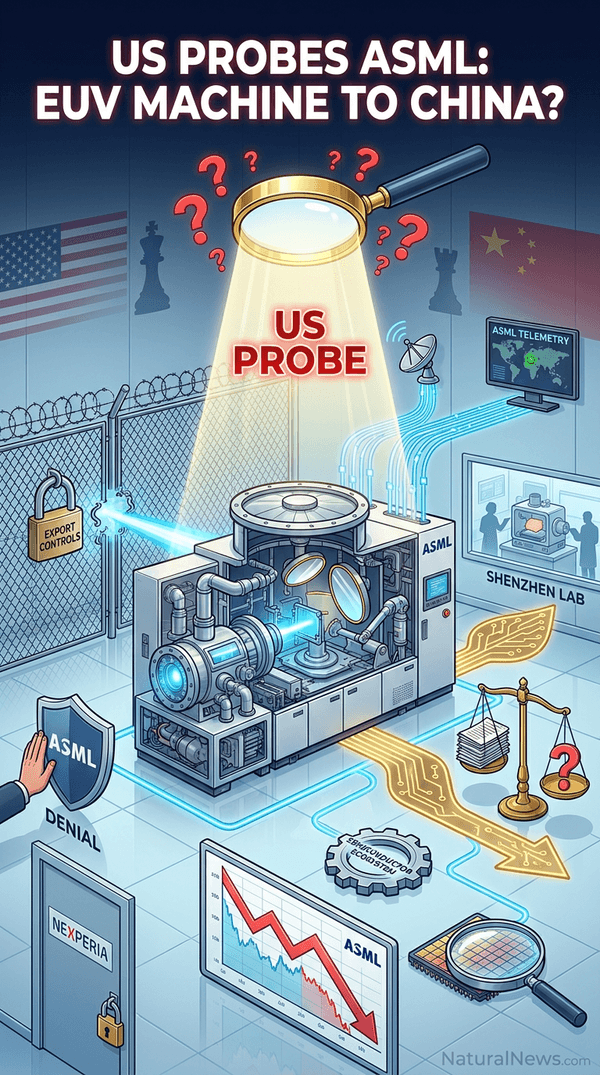
Explainer Infographic
Submit a correction >>
Tagged Under:
ASML, big government, China, chipmakers, economics, EUV, export control, extreme ultraviolet lithography, future tech, inventions, national security, products, regulation, semiconductor, supply chain, trade, Trump
This article may contain statements that reflect the opinion of the author
RECENT NEWS & ARTICLES