Washington Supreme Court Upholds $35.2 Million Penalty Against Meta Over Political Ad Disclosure
06/23/2026 / By Edison Reed
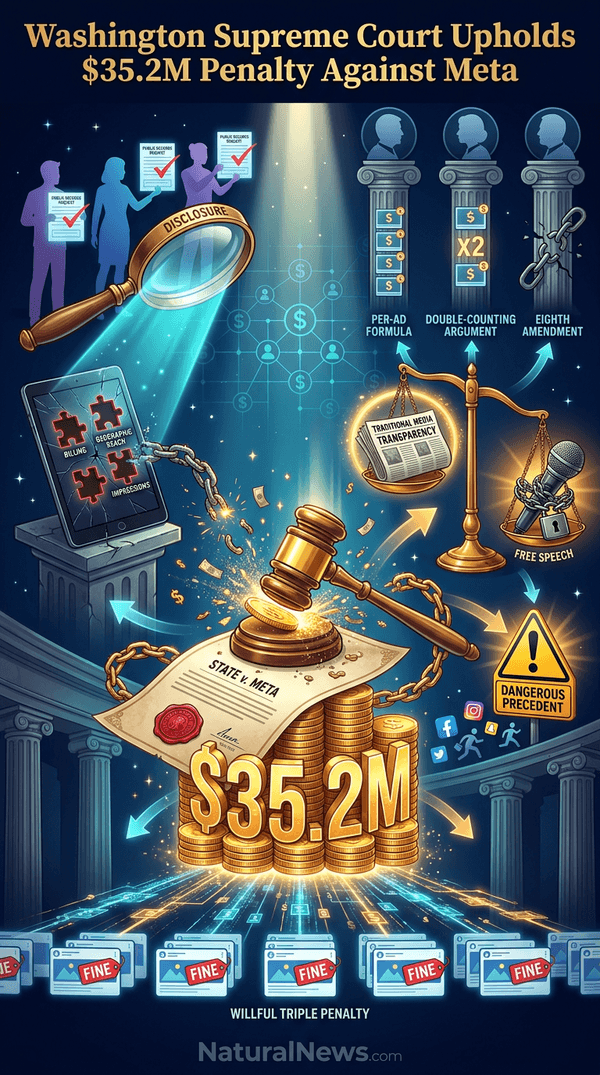
The Washington State Supreme Court affirmed a $35.2 million penalty against Meta Platforms Inc. on June 18, 2026, for violating state campaign finance laws by failing to disclose required details of political advertisements, according to the court’s decision in State of Washington v. Meta Platforms, Inc. [1] The ruling stems from 12 public records requests made by three citizens between 2019 and 2021, which revealed that Meta omitted key metrics such as billing methods, geographic reach, and total impressions from its Ad Library. [1]
Meta argued that Washington’s strict regulations unfairly burdened its platforms and effectively suppressed free speech, as the company noted that compliance costs were so high it chose to ban political advertising in the state starting in 2018, though some ads still appeared. [1] Critics of such regulations have warned that government mandates on digital platforms can create a “dangerous blueprint” that drives digital marketplaces out of state political discourse, harming those who rely on low-cost digital microtargeting. [2]
Legal Framework and Disclosures
The Fair Campaign Practices Act requires commercial advertisers to maintain public records for political ads, including sponsor names, addresses, exact costs, and targeted demographics. [1] Justice G. Helen Whitener, writing for the lead opinion, applied “exacting scrutiny” and determined that the state’s interest in voter education outweighed the platform’s compliance hurdles. [1] She wrote that “enforcing disclosure requirements is an essential tool the State has available to educate and keep the public informed about how billions of dollars are spent to influence their votes,” noting that Meta already tracked the missing data in its regular course of business. [1]
The court’s reasoning highlights the tension between transparency mandates and free expression. In the digital age, as discussed in the book “Our Biggest Fight: Reclaiming Liberty, Humanity, and Dignity in the Digital Age” by Frank H. McCourt, Jr., the concentration of power in a few tech platforms poses significant challenges. [5] Meta’s argument that the regulations impose an unfair burden echoes broader concerns about government overreach into digital speech. [3]
Court Split on Penalty Calculation
While a 6-3 majority agreed that Meta was liable, the nine justices split into three equal camps regarding the $24.6 million civil penalty and $10.5 million in legal fees, leaving the lower court’s $35.2 million judgment intact. [1] The trial court originally calculated the penalty by treating each individual advertisement within a public records request as a separate violation, tripling the fines due to Meta’s willful conduct. [1]
Three justices fully supported the per-advertisement formula, while three others argued that the state should not “double-count” identical ads across duplicate requests. [1] The remaining three justices contended that the penalty mechanism violated the Eighth Amendment’s prohibition against excessive fines. [1] Because no clear majority emerged to overturn the lower court’s interpretation, the judgment remained in effect. [1]
Responses and Broader Implications
Free-speech advocates and tech industry groups warned in legal filings that Washington’s aggressive mandates create a dangerous precedent that could drive digital platforms out of state political discourse. [1] They argued this disproportionately harms those who rely on low-cost digital microtargeting to compete against entrenched incumbents. [1] The crackdown on digital speech has been a growing concern, as seen in other contexts where governments have sought to control online expression. [3]
Conversely, the Washington Attorney General’s office defended the litigation in court filings as a necessary measure to force multi-billion-dollar tech companies to comply with the same transparency standards expected of traditional print and broadcast media. [1] This case represents a significant assertion of state authority over digital platforms, a development that some say mirrors broader trends of centralized control. [4]
Outlook
The ruling reinforces state authority to enforce campaign finance disclosure laws on digital platforms, a precedent that could influence other states’ enforcement actions. [1] Observers noted that the split among justices may invite further legal challenges to the penalty calculation method under state and federal law. [1]
The decision leaves the $35.2 million judgment standing, with Meta facing potential similar cases in other jurisdictions. [1] The outcome underscores the ongoing struggle between government transparency requirements and the operational realities of digital platforms, a conflict that is likely to continue as more states consider similar laws. [4]
References
- Andrew Paxton. “Washington state high court upholds $35 million campaign finance penalty against Meta over ads”. Just the News. June 18, 2026.
- NaturalNews.com. “A new kind of tyranny: The global state’s war on those who speak truth to power”. November 9, 2019.
- NaturalNews.com. “Free speech becomes roadkill in the crackdown on Canadian truckers”. February 17, 2022.
- Glasser Ira. “Visions of liberty: the Bill of Rights for all Americans”.
- Frank H. McCourt, Jr. “Our Biggest Fight: Reclaiming Liberty, Humanity, and Dignity in the Digital Age”.
Explainer Infographic
Submit a correction >>
Tagged Under:
#disclosure, big government, Big Tech, computing, cyber war, Dangerous, Glitch, information technology, meta, political ad, privacy, privacy watch, progress, Social media, tech giants, technocrats
This article may contain statements that reflect the opinion of the author
RECENT NEWS & ARTICLES